
Challenges of Becoming a Private Pilot: The Truth About Cost & Time

Becoming a pilot is a dream thousands of people pursue every year. The freedom to go anywhere and see anything, the thrill of commanding an aircraft, and the great sense of accomplishment are attractive. Yet, the harsh reality is that roughly 80% of student pilots drop out of flight school before they ever receive their pilot certificate.
So, what stops most people? What is the biggest challenge of becoming a private pilot? It’s not the fear of flying, difficulty mastering landings, or the checkride. It isn't confidence or hand-eye coordination. It isn't learning to talk on the radio or to deal with the weather. It isn't the written exam or completing ground school. It isn't cross country or night flying. These are certainly challenges, but these are the good ones!
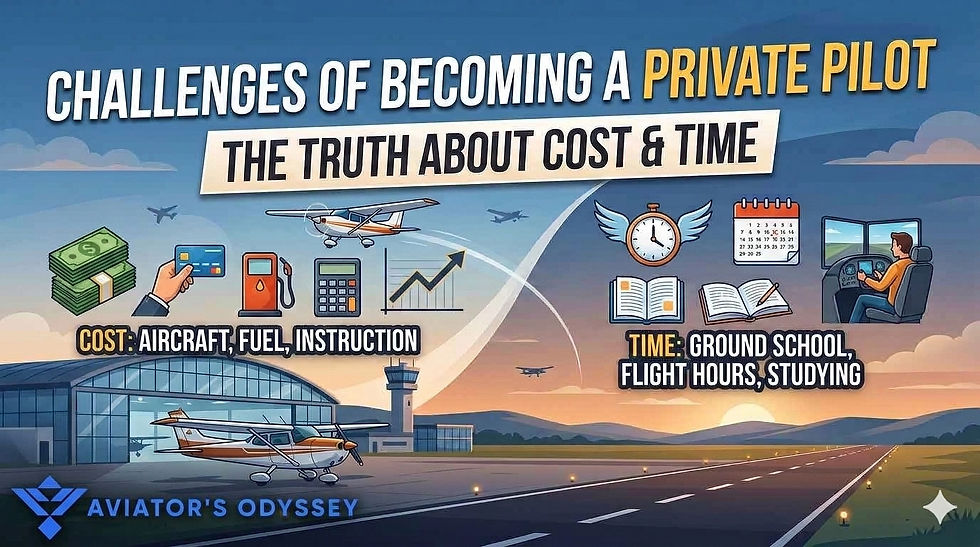
The biggest challenge that prevents people from completing flight training and getting their private pilot certificate is the combination of high cost and the need for consistent time commitment. These two factors compound each other and lead to frustration, financial strain, and eventual dropout for 80% of flight school students.
This guide breaks down the biggest challenges of flight school, and how to save time and money during flight training.
How Much Does It Really Cost to Get a Private Pilot License?
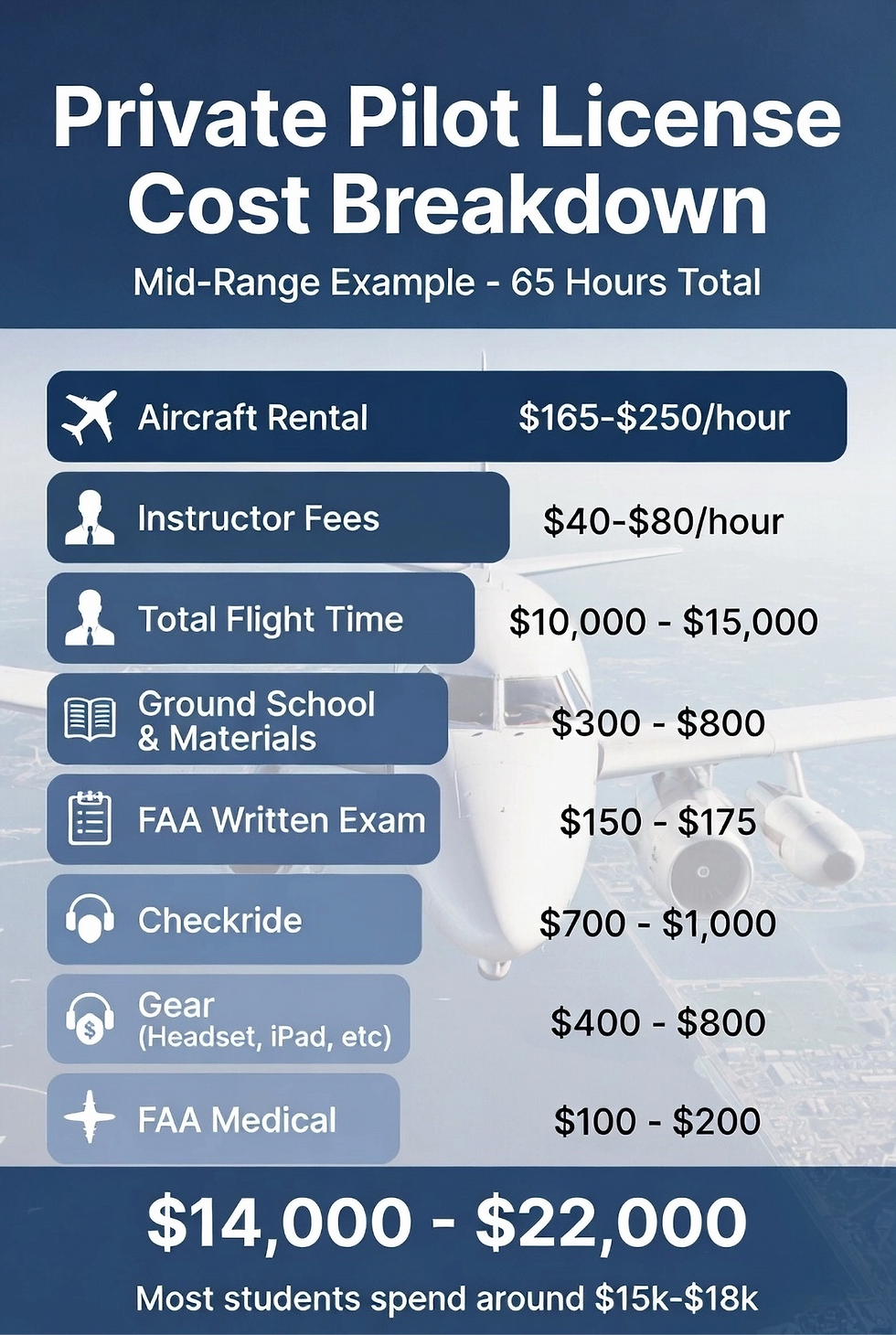
Cost is the number one reason most students quit. The aircraft rental and instructor costs add up quick. Adding the exam fees, materials, gear, and medical, the final cost can be frightening. Once people start seeing the money leave their account, it can be a shock how expensive flight training really is. However, if you find a good school, and stick with them, they might be willing to work with you on the cost.
Here's a breakdown of the cost of a private pilot certificate.
Long breaks between lessons caused by bad weather, or instructor/aircraft scheduling issues can cause skill degeneration which in turn will increase the total flight hours required to complete flight training.
How to Save Money During Flight Training
My number one piece of advice is to fly often. Push for 3-4 times per week if you can. Get on the schedule at least. That way if one or two of your flight gets canceled due to weather or maintenance, or any other issue, then you're not taking weeks off in between flights. Flying consistently is the best way to save money. Just being in the building 3-4 days a week will keep your mind focused on training. It will help you gain and retain proficiency, and meeting with your instructor frequently will keep you engaged.
Go prepared to every lesson with specific points of training you're going to focus on. Read up on the topics in the PHAK, and Airplane Flying Handbook, and the ACS before each lesson. You're going to study your butt off if you want to save money. Invest in a good online ground school. (I used Sporty's which I highly recommend.) Also, invest in some sort of flight simulator. It doesn't need to be one of the high-end sims. MS Flight Simulator will keep your mind sharp and help with chair flying, which is a major tool for flight training. Running through emergency procedures on MS Flight Simulator will prepare you for in-flight training, allowing you to build real proficiency and prepare for a real-life emergency scenario. Safety First!
Last but not least, choose the right flight school. An experienced, knowledgeable instructor that's going to stick around and see your flight training through to the end is an invaluable resource. Try to find a career instructor, instead of someone who is just building hours until they can leave for the airlines. It's nice to fly with those guys because they're usually young and eager, but if they leave in the middle of your flight training you'll end up paying for it when you have to do some review flights with your next instructor. Having a career instructor will help you become the best pilot you can be, and it will save you money in the end. You want to make sure the school keeps their planes in good shape too. That way you're not getting grounded all the time due to maintenance issues. Check in with the local maintenance team at the airfield and ask for their opinion on the school. Those guys usually know everything about planes and are awesome to talk to.
How Long Does It Really Take to Get a Private Pilot License?
While the FAA requires only 40 hours at the bare minimum, the national average is closer to 60–75 hours for part-time students.
The 40 hour minimum likely originates from the Civilian Pilot Training Program (CPTP) of 1939. Just before WWII, the government launched this program to develop a civilian based pilot reserve in the USA. Through partnerships with colleges and flight schools, it delivered intensive, full-time training, typically 35–50 hours of flight time combined with 72 hours of ground school. Students often flew daily in simple tailwheel trainers like the Piper Cub from rural grass strips. By 1944, the program had trained over 435,000 pilots.
Several factors allowed faster training back then: consistent daily practice with little skill decay, far less congested airspace, simpler aircraft and regulations, highly motivated students, and a higher tolerance for operational risk during wartime. Also, the government probably wanted to hand out as little money as possible, so they kept the hours as low as they could.
Today’s reality is very different. Most students train part-time, flying just once or twice a week, which leads to skill decay between lessons. Modern training involves complex airspace rules, advanced avionics, strict ATC procedures, and much higher safety standards. Instructors emphasize mastery over minimums, requiring extra time on cross-countries, night flying, emergencies, and risk management.
Weather delays, aircraft scheduling, and deeper knowledge requirements for the written exam and checkride further extend the timeline. The 40-hour minimum remains a legal floor, achievable mainly by full-time students under ideal conditions, but it is not the norm. The extra hours today reflect a safer, more capable pilot for our highly regulated 21st-century skies.
How to Save Time During Flight Training
The advice for saving time during flight training basically mirrors the advice for saving money. The vast majority of the cost of flight training is instructor time and airplane rental costs, so saving costs is dependent on saving time. Let's dial in on how to make the best use of your flight time.
Most students spend the largest portion of in-flight training time on landings. Landings are particularly challenging because they demand precise control, good judgment of the "sight picture," and handling variables like wind. The single greatest piece of advice I can give here is to tell you that during every landing you should be transitioning your focal point to the end of the runway. DO NOT look at the runway right below the nose during your flare.
Your aiming point should be in the windshield during final. Once you pass the aiming point, you should be transitioning your focal point to further down the runway. As soon as you round out, your eyes should be looking at the far end of the runway. Your central vision handles detail and alignment, while peripheral vision excels at detecting motion and changes in height. As the nose rises in the flare, focusing on the far end of the runway helps you maintain the sight picture and control the gradual increase in pitch until the main wheels touch. Transitioning your focus will help you maintain stability and perform proper wind correction inputs on the control yoke. It will help you stay aligned with the center line. It will help you judge your height above the runway. It will help you judge your rate of descent. Every data point your brain needs while you're holding off during the final stage of landing depends on you transitioning your focus to the far end of the runway. Force yourself to do it. Master where to look.
Mastering where to look is a huge part of why students spend so much time on landings, and it directly translates to smoother, safer touchdowns. The faster you do master where to look, the faster you'll pick up landings. The faster you pick up landings, the less time you'll spend on flight training. The less time you spend on flight training, the less money you'll spend.
Conclusion
Flight training is not easy. You can take the most systematic approach to it and life will smack you in the face with some surprise. The question is: how determined are you? How will you respond when you're face to face with that hurdle? How will you react when the going gets tough? Because it will get tough. You will face a challenge. You will question whether or not you can do it. You will doubt yourself. It's in that moment that you need to take a leap of faith. Chase your dream. Follow through. It is worth it. It will change your life.



Comments